Riding to work again today led me to have cramp in my right foot. I've had this before, not sure why. What is strange is that it happened in exactly the same place approaching the same roundabout.
"This is weird" I thought and also potentially dangerous. Getting cramp in my right foot, while riding along in SPDs and I couldn't easily twist my foot to release it from the pedal.
It got worse. Then I had cramp in my LEFT foot at the same time! There I was slowing down just before a roundabout which 90% of the time I have to stop. Stopping means I have to release one foot, normally my left foot, simply to put my foot down and prevent me from falling over. No option but to force my left foot to twist itself out and just as I did that the cramp stopped.
There were no cars after all so I re-engaged my foot and blasted on and both feet now felt looser. Phew.
This really is strange. Why does it happen? Even more so, why in the same place? I had ridden about 10 miles and just slowing down - is this significant in anyway?
It makes me appreciate my feet. They get punished so much, all that running, cycling and just standing around. I have broken a couple of toes in separate instances which healed quickly without problems. Like hands, amazing structures but why do I get these cramps!?
Showing posts sorted by relevance for query cramp. Sort by date Show all posts
Showing posts sorted by relevance for query cramp. Sort by date Show all posts
Monday, 1 August 2011


Saturday, 31 August 2013
Hymalayan Salt - my cure for cramp?
 |
| Rose pink crystal salt |
Seems that it is salt with a difference - i.e. it is unrefined - not mucked about with, processed, jazzed up, over packaged. It has some 84 elements within it, apparently the same as is found in the human body. These elements are in colloidal form, meaning they are small enough to be absorbed into the body, so that's a handy thing to know. It comes from the natural waters in the Himalayas and is harvested naturally and by hand. There are no additives (such as anti caking agents, bleaches and so on) and this explains why it is presented in such an unusual form - small pinkish coloured crystals.
The idea of us trying this out is three-fold:
- seasoning for our food; perhaps bringing a nice, new taste
- could this be a possible cure for the cramp I seem to suffer from more these days
- it's something new for us to try
I mentioned about cramp. Yep I get cramp in my toes, feet and legs quite a bit these days. The most inconvenient time is when I'm on my bicycle with my feet locked into the pedals courtesy of SPD pedals and shoes. I tell you, that can be pretty scary at over 30mph. Take a look at this article for the full account.
Mind you, while I'm looking forward to trying this salt out, I'm going to be careful I don't end up taking too much salt in. No matter how good this is, too much salt can raise blood pressure which is best avoided these days for us all.
So there you go. Some new salt which is possibly millions of years old and costs £3.99 for 500g. It is supplied wholesale by http://www.profusionorganic.co.uk. Whether it cures my cramp or not - we'll wait and see!
Friday, 17 July 2015
Cycling, running and cramp
If you ever listen to the excellent Radio 4 programme Inside Health, presented by Dr Mark Porter MBE, you might know he sometimes invites listeners to get in touch with health queries. Here's mine.....

Dear Dr Mark,
From time to time I get bouts of cramp, mainly in my legs and feet. When I get cramp it is often at night and a muscle seems to go into a kind of stiff spasm and be very taught. I can tell you, it can be dramatic waking up at night with an agonising pain in either my left or right leg. It scares the living daylights out of my wife who will often wake up as well, very startled at me leaping and hopping around the bedroom.
It seems to generally affect one muscle at a time, either in the upper or lower part of my leg. It's the same with my feet but that's not quite so painful as I guess the muscles are smaller.
While I get cramp mostly at night, it sometimes happens when I cycle and believe me, this is a little disconcerting when you have both feet clipped into the pedals. Like many other cyclists, I use a clipless pedal where your cycling shoes are locked to the pedal. Releasing your feet is done by twisting the heel outwards and then the shoe springs out.
Me, my health
I am in my mid fifties and have no health issues. I'm pretty active and fit with running (I average over 20 miles each week) and cycling. My BMI is 22.5 and I'm in pretty good shape. I'm tee total, don't smoke and I'm a vegetarian. I reckon my diet is pretty good generally; I especially eat lots of fruit (as many different kinds as I can over the course of a week).
My own Doctor
Every year I make sure I get a health check covering the usual things such as blood pressure, cholesterol, liver and kidney function etc. These are all fine and my Doctor says "well done, keep it up".
I did mention the issue of cramp to my Doctor. She said that she wasn't very knowledgeable about it and flicked through my notes and said there was no obvious reason. She felt behind my knees and then held my feet in her hands and commented they were colder than she expected, although it was a chilly day. Other than that there was nothing to say or do apart from "I could suggest you give up running any cycling but I doubt if you'd think that was a good idea!".
Electrolytes
Some people suggest sports drinks to be a solution and yet there are many different types around. I have tried taking some electrolyte drinks which might help but I cannot be sure, there's no regular pattern.
Any suggestions?
Goes without saying I'm hoping you can cover this on Inside Health, I'm happy to be interviewed or provide some further information if that would be helpful.
Links:
Radio 4 Inside Health
Electrolyte drinks - do we need them?
Links:
Radio 4 Inside Health
Electrolyte drinks - do we need them?
Friday, 9 March 2012
Commuting by bike - problems to overcome
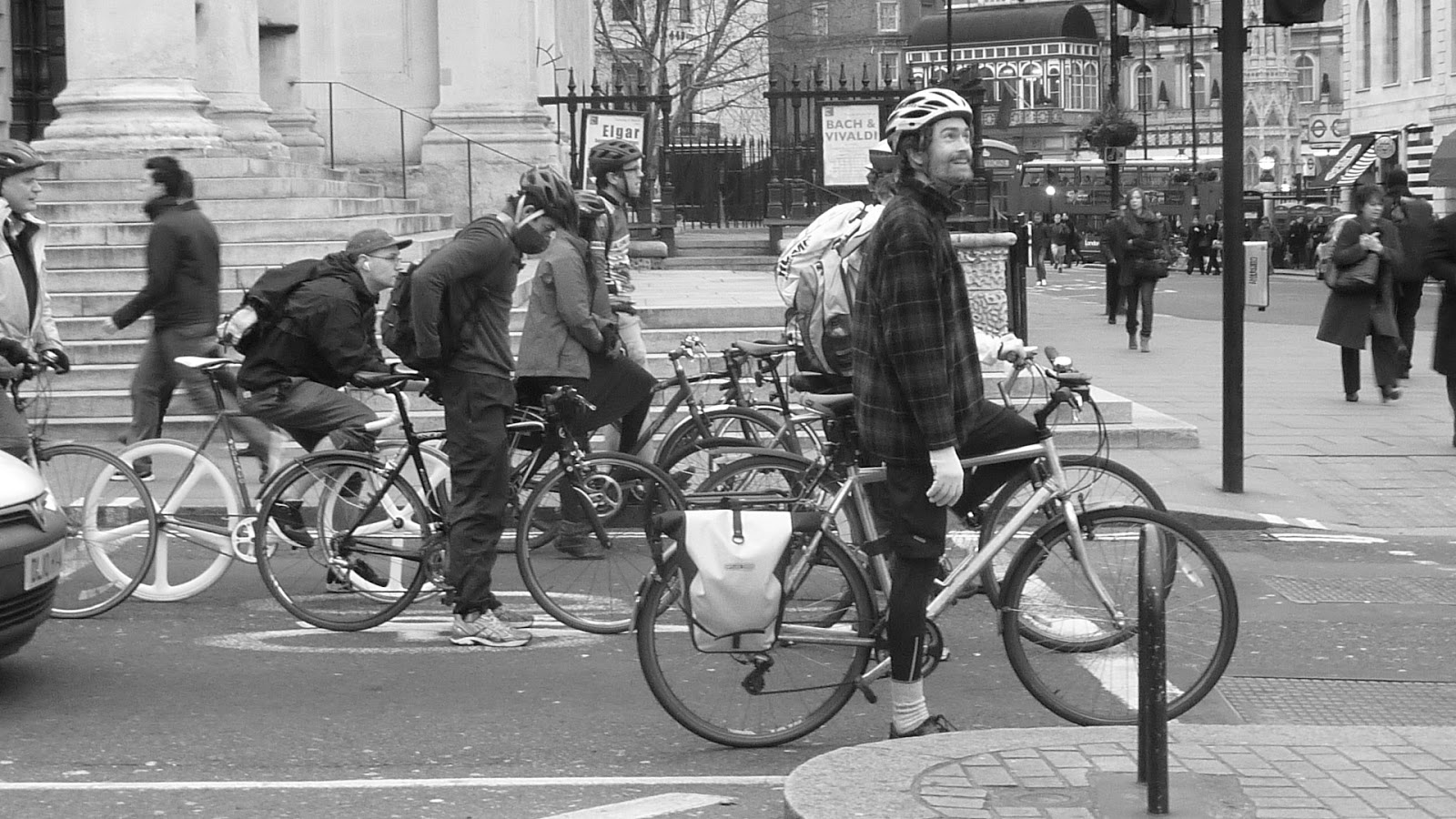 |
| Cyclists in pole position at Trafalgar Square traffic lights |
- Clothes, shoes etc. Sometimes I get myself organised and make sure I have clothes at my office, ready for me to change into. Other times I take a change of clothes each day. The main thing is having a shirt which won't become too crumpled looking. I always keep a spare pair of shoes under my desk but I do bring them home to give them a good polish from time to time - otherwise the leather will totally dry out! I always smile when I'm so obviously in my cycling gear (yellow jacket, helmet, clicky shoes) and someone in reception asks "Have you cycled today Doug?".
- Body odour! As we don't have showers, and if I'm really in need I have a quick wash in the "bathroom". I do not like to use de-odourant but sometimes do make an exception.
- Bad weather happens less than we think here in the East of England; a relatively dry part of the UK. Squally winds and freezing temperatures are the things that I loathe the most. This is where the correct cycle clothing comes into play. Having cycle specific clothing is an investment worth making if you plan to cycle often.
- Squashed lunch might seem a daft problem but I can tell you, squashed cheese and pickle sandwiches just doesn't look good by lunch time! Even worse than being squashed it where they fall to bits! A lunch box is useful, depending on how much space you have. Otherwise pack more robust things like flapjacks and apples
- Fear is real. Fear of cars, accidents, pedestrians, lorries and so on. The solution is found in being visible with lights and a yellow jacket where appropriate. Otherwise confidence, experience and a good road sense will help,
- Papers take up lots of room and can be heavy. Planning ahead and having pannier bags are my solutions as I often have to attend meetings elsewhere on different days. Sometimes I have to take papers for several meetings and these can seriously slow me down. Just as well I have not been "especially chosen" to have a laptop, I'd only lose it or leave it somewhere.
- Cramp is a bit of a problem for me but only in my feet. I have rambled about this before and it does bug me sometimes. I get it in some of the muscles in my feet, normally one at a time but when it strikes in both feet together, that can be a bit scary. I think the most probable cause, in which I could do something about, is the shoes I use and keeping my feet warm and dry enough. Click here for a review of my shoes. Click here for a ramble from last year about getting cramp.
Friday, 13 January 2012
Specialized Sonoma shoes - review

I've had these shoes for about 3 or 4 years and probably a good enough time to do a blog review.
What are they?
They are made by Specialized, well know maker of mid priced bikes, bits and clothing - the Panasonic of the cycling world, perhaps. The shoes are aimed at a general purpose cyclist, combing a reasonable performance on the bike with the ability to be used for walking around. They don't look too weird, if you're off they bike either in appearance or when walking along in them
Construction
The Sonomas seem fairly well made. The sole is smooth rubber which is reasonably stiff and surprisingly grippy. The uppers are a combination of suede leather synthetic leather supplemented by a black mesh (which is obviously not rain proof). The three Velcro straps are great and there is a reflective toe and heel strip.
Cleat installation
This is simple enough. I use Shimano SPDs and it was easy enough to find the right position for the SPD cleats, held in with Allen key bolts. Naturally there is a certain amount of trial and error. The cleat is recessed sp although it won't cause any problems walking along, it does seem to amplify the sound of grinding gravel when walking on rough ground.
Performance
Seems fine, probably their greatest strength lies here. They are reasonably rigid and good on the bike, giving the feeling of not compromising the power transfer from feet to pedal.
Cost, value for money
The current price seems to be around £45 which I think is pretty good value for money. I have had for several years and they have been ridden for several thousand miles. Considering they are at the budget end, they're very good, all things considered.
Comfort
This now is the weakest area in my view. The fit, is however, okay but for some reason I ended up with a pair that is too large for me (don't ask why, I can't remember). I find my feel feel a bit "drawn" in them which maybe due to the synthetic nature of the materials used. The biggest problem is with me getting cramp. Yes cramp, both feet but never both at the same time, thankfully.
Would I buy them again?
Maybe but although they look very nice and perform well, I think I could do better but not for the money.
Does this help?
Sunday, 13 September 2015
What should I eat before the Rock Solid Race?

Some of my friends are doing another obstacle race soon, namely the Rock Solid Race, also known as an Obstacle Course Race (OCR) which is a military type course. It involves some running, climbing, crawling, pulling, pushing, lugging a log around and so on. In length it will be 5 - 10k and might take 1 or 2 hours to complete. In other words it is a good all-round workout needing strength, stamina, agility and some confidence to do those crazy things!
My friend John is always keen to adopt best practice when it comes to these events (and I'm quite impressed by that). This shows itself in his preparation, training, knowing what to do at the event, what to wear and so on. He has now specifically asked about nutrition.
First of all, John has volunteered his previous nutrition as:
Breakfast at 7:30am
Cornflakes
Two slices of toast
Cup of tea
Morning snack
Cereal bar
During OCR
Cereal bar
After OCR
Sandwiches x3
Cake
Here are my thoughts:
John is taking part in a demanding OCR and it will be at a time of year when it will be pleasantly warm but not too hot. I am working on the basis there are no medical problems and this is simply general advice. I should say John is around 15 years younger than me, slim and looks a good healthy weight.
Hydration starts the day before. Make sure you drink plenty at least 12 hours before the OCR and this will make sure the body is well hydrated. Now I am not talking alcohol here (especially as I'm teetotal myself) but instead the usual glass of water, fruit juice or tea etc.
Carbohydrates is an interesting topic. Many athletes and sporty types talk about carb-loading in the days before an event. I don't think this is necessary for this event, general fitness and no excessive food is required. Yesterday I ran a half marathon in 1:45 without drinking or eating anything on-the-go. If I was going much further I would need rehydrating and taking on a little food.
Breakfast needs to be a normal meal as it is several hours before the event - it's still good to build up a little fuel in the tank here. I am not a fan of cornflakes as they are often processed and refined foods, laden with sugar and additives. I think John has shop-bought white cotton wool bread, though he has been rumoured to have a slightly healthier "half and half". I asked John what he puts on his fruit and he replied "Marmalade".
"It's all very well having marmalade but don't think it counts as fruit i.e. one of your five-a-day" I commented. John looked a little disappointed. Sorry John.
They say breakfast is the most important meal of the day. I certainly treat it that way and make sure I get a good mixture of different foods i.e. fruit, a glass of smoothie (I like a wide variety) and some gravel. Gravel, by the way, is what my wife calls my muesli. I'll tell you another time about what goes into my gravel.
So John, make sure your breakfast is more wholesome, it should include some fruit (perhaps either whole fruit or a smoothie or fruit juice). Try something like this:

This is a typical breakfast for me. Smoothie with gravel. On the gravel you can see there is some chopped up fruit with some yoghurt making this a very healthy meal, full of goodness.
Mid morning snack needs to be something easily digestible and not too heavy going. Have whatever you fancy and ensure your fluids are maintained. You could try one of those energy drinks I gave you. There's no point in having something fizzy as this is just short term, quick burn sugar. Something with some carbohydrate and protein will be okay. Don't go trying anything new just before a race - if it doesn't "agree" with you you'll be risking blowing the whole event and end up feeling awful.
The race itself! For the OCR you shouldn't need anything else. You should be sufficiently fuelled within yourself.
Having learnt myself from making the odd mistake, I can tell you that running with undigested food in my stomach is absolutely horrible. It is probably the closest I'll ever get to feeling pregnant. Pregnant with twins no less.
After the race is still important when it comes to your nutrition. You see, when you run or do any OCR you are putting a lot of strain on your body - muscles, joints, tendons and ligaments all taking some damage. Repairing this damage needs good quality protein and some antioxidants. John will remember our friend Nettie posting photos of her bruised knees! This is an outward sign of the battering our bodies get and clearly needs repairing.
 Protein comes in many forms and in many foods, excellent for building muscles etc. Antioxidants help mop up free radicals which are released during exercising and these, if unchecked, can be harmful. So even something as straightforward as a banana is very good. You could go one step further and have a fruit juice and a muesli bar.
 If you get cramp at all, this could be a sign of running low on some minerals / electrolytes which again bananas or other fruit can help with. High 5 and others often do electrolyte drinks which are good for this. On the other hand, cram is not fully understood by the medical profession and it can be linked to a number of possible causes. Linking cramp to a nutritional deficiency does seem plausible.
Wrapping up
- Make sure you include more fruit in your diet before and after the event
- Don't eat too much immediately before the OCR or you will feel bloated (or pregnant!)
- Make sure you are well hydrated
- Make sure your pre event foods include the right mixture of proteins, carbohydrates etc
- Make sure you have some recovery food ready afterwards such as a banana, fruit juice or a commercially made recovery drink
I could waffle on for ages about all kinds of other good foods to eat i.e. making sure we get our Omega 3 and 6, getting the soluble and insoluble fibre mixture right. The most important thing is to ensure you eat a wide variety of good, wholesome and natural food.
Enjoy your food, enjoy knowing it is doing you a whole load of good!
Tuesday, 27 January 2015
Which is harder?
Crikey, I have recently entered the Milton Keynes Marathon, this will be the third time I've done this event. I didn't do it last year as I concentrated on cycling so I could compete in the Coast to Coast in a Day event. This was 150 miles on the bike over a very hilly terrain.
So, which do you think ought to be harder? Running a marathon or cycling 150 miles?
My gut reaction is a simple answer – running a marathon is easier, for me. And then the more I thought about it afterwards the more complex the comparison seemed.
So, which do you think ought to be harder? Running a marathon or cycling 150 miles?
My gut reaction is a simple answer – running a marathon is easier, for me. And then the more I thought about it afterwards the more complex the comparison seemed.
Firstly, to cycle 150 miles it might be worth considering what is involved. It took me a little over 13 hours to complete the hilly distance earlier this year and this included four feeding stops (probably about 15-20 minutes at each) and a ferry trip across Lake Windermere. Compared to the 700 other cyclists this time was slower than average, even when taking my age into account. Getting ready took several months of training, gradually increasing the distances to the point I was fairly comfortable covering over 100 miles in a day – building up gradually is the key here, with a number of shorter rides in between the longer weekend rides. The shorter rides are important, either for simply keeping those muscles, ligaments etc in good shape, for getting used to some steep hills or some brisker rides to keep my heart rate up to a higher level for a longer period.
For running a marathon, the format is remarkably similar. I aim for a long run at the weekend and shorter runs during the week and these involved a few hills (which I absolutely love), some shorter sprints (bringing a dose of the Runner’s High) and simply a few short jogs around my local neighbourhood to stay fairly supple.
In running a marathon, it takes me about four hours, give or take a little, to run the 26.2 miles. This is running at a steady, constant pace throughout. There are no stops for feeding or drinking – this is done on the move and “little and often” seems to suit me best. The only possible reason for stopping briefly is to use a Portaloo or at the direction of a marshall, so really it is non-stop, all the way.
The events – how they might compare
The Coast to Coast in a Day is not a race, although there is a hint of being in competition with each other or, at the very least, in competition with the clock and yourself. After all everyone is given a timing chip and cyclists are identified as gold, silver or bronze according to their time. You have a fairly broad window in which to start; if I remember correctly this is over two or three hours.
Running a marathon is completely different. Everyone is lined up against the starting line waiting for the gun to send everyone off. We also have timing chips which generally differentiate between the chip time and the gun time, since it can take several minutes to actually get over the start line owing to the 2000 – 3000 other runners.
Coming in towards the finish line is also different. With the marathon it is a case of one last push in trying to shave off a few seconds and come in with a real rush of the Runner’s High and the need to walk or jog a little to aid recovery. After a long 150 miles the applause was just the same but the focus is on having completed the gruelling challenge and never mind the time.
The mental challenge
It is easy to chart a physical training programme and record your progress, increasing long ride miles each week or two (20 miles, 30 miles, 80 miles, 95 miles….). Training ourselves mentally for the challenge is more subtle and less easy to pin down. It is influenced by personality, natural determination, how easy it is to do physically and a whole range of other factors. And yet we shouldn’t under estimate what part this has to play in an endurance event. Being physically fit is essential, yes of course, but I would argue you must be mentally prepared as well. In preparing mentally for a challenge, it is not simply a case of building up the miles.
Taking part in running a popular marathon you’re surrounded by other runners, pretty much all of the time and the effect is to sweep you along. I tend to run a little faster in this situation, which I suppose is part of the general idea. This doesn’t stop the occasional feeling of being low and down, this can happen at various points when it seems a struggle. Cycle events are at times more solitary with people starting at different stages and the field stretching our more easily. It could be argued that the mental challenge is the biggest challenge of all; having the grit and determination to keep going when it all seems to be too much; this used to be referred to as “character building” by unhelpful, well-meaning people. Sometimes the monotony of the cycle training used to get to me, particularly on the same roads, in the same bleak weather, the same irritating rattle all added up to be uninspiring at times. I used to allow my mind to wander onto other things, quite often cycling-related and tried to be positive and this generally worked. Nevertheless there were low periods when it seemed sensible to ask “why am I doing this….?”
It was using my bike on the cycle turbo trainer which was arguably the most difficult. I still do not like it and find it very unmotivating. I can only see it as a means-to-an-end. Some people I know rate spinning classes quite highly and enjoy them, so this could be a possibility in the future.
Sometimes thinking of some kind of a reward is motivating. When I used to be out cycling last winter – and not always enjoying it – I used to think of that red hot shower I’d have when I got bcd to warm myself up, or that lovely coffee with a slice of cake containing 1000 calories. I used to think of losing a little more weight. When I did the Coast to Coast I “gave myself permission” to go and buy myself a carbon fibre bike afterwards (and I still haven’t got around to this and I doubt if I will).
Sometimes any of us will hit a bit of a wall, when our energy levels seem to drop and legs feel like jelly. Generally this lasts about 5 – 10 minutes and occurs around 20-30 minutes in if I’m running and a little later if I’m cycling.
It is also a tricky challenge in the training, for either discipline, when you’re out in bad weather slogging away and questioning why you’re doing it – I find this is a healthy question to ask and reflect on. It was during the Coast to Coast cycle ride that I once hit a low patch, somewhere in the second half when I found myself cycling alone – this was unusual in that event. I also remember feeling a bit fatigued and had cramp. That was the lowest point and probably the most testing. It was also a point where I had to stop because I had cramp in my upper right leg which was extraordinarily painful (I still remember that!). And yet no matter how bad it became, there was no way I was going to give up: I knew I was being tested in a way.
So, which is the most difficult then?
For me, it is cycling 150 miles. Running a marathon seems “easier” by comparison. However, that’s just me and thank the Lord we are all different.
Tuesday, 2 August 2011
Cycling in harmony with your body

Once more I cycled to work, had cramp in my right foot yet AGAIN (see previous post) and missed a new PB by just a few seconds - soon I will arrive in under 46 minutes. It felt good and I was in need of a shower. We don't have showers in our part of the Ministry of Justice and so it is just as well I have an office for myself.
Through the day I was looking forward to my ride home. I got loads done today, quite satisfying working through that To-do list and seeing plenty of things crossed off.
Called home, logged off, got changed and I was off. The ride was notable for a few reasons and this is what this blog post is really about:
I was wearing a sort sleeve jersey and from time to time I found myself looking at my hands and arms as I pushed hard along an open A road in the countryside. I was fascinated by watching my muscles working around my hands and forearms. I then became aware of how cycling involves plenty of upper-body exercise and strength as I clocked then the way my shoulder muscles were working, not to mention my hand which still hurts following that fall in January!
I took a longer, hillier route coming home which added 3 miles. That meant I could ride over the top of a hill with a tremendous view of perhaps 30+ miles. The view was inspirational with magnificent clouds with some showers in the distance and some brooding stormy clouds too.
The weather forecast suggested I could expect a downpour which just did not happen. At one point I could feel a few spots of rain and I was hoping for more - I just love being out in those summer downpours!
The important thing for this ride was the feeling of being in some kind of harmony where everything just felt good. Physically it was fine, the conditions could not be better and the bike was running well. My breathing and heart rate seemed fine being under a bit of load as I pushed myself; I could feel I was working hard and yet in almost complete harmony. It just all came together.
Friday, 23 January 2015
Raspberry smoothie recipe
 |
| Raspberry smoothie |
My Mother-in-Law is a bit of a hoarder at times and this applies to her stash of frozen raspberries, as well as 40 year old home made mead in her cellar. So I'm thankful for a couple of things: firstly that she doesn't read my blog, secondly she's happy for me to work my way through her frozen raspberries. They are now mainly of 2008 vintage, as the younger ones have now been consumed.
I do like raspberries, one of my favourite fruits and they do remind me of summer so much. Below I will expand on their health properties along with the other fruit. Firstly, here's my recipe for one of my favourite smoothies:
4oz Raspberries
1 Pomegranate
Quarter of a pink or red grapefruit
Apple juice and/or water for preferred consistency
Method
Couldn't be easier. Wash or defrost the raspberries. I normally check them over as raspberries are a soft and delicate fruit, so avoid any bruised or damaged fruit. With the pomegranate, cut into quarters and spoon out the pink flesh, discarding the skin as best you can. Pink or red grapefruit is best and use about one quarter, peeled and cut into small slices.
Put all of the fruit into a glass jug, add some juice or water gradually and then use a sharp hand blender to whizz them all together into a scrummy smoothie. I don't mind having a slightly thicker, soup-like smoothie but I imagine many prefer a more liquid consistency.
Why this smoothie is so good
Above all else, this is a kind of "cleansing" smoothie and delicious. This is why:
Rasperries contain Vitamins C and B3, folate, biotin, folate, manganese, citric acis, fibre and some sugars. Also, according to Eating for Immunity by KirstenHartvig, raspberries activate the body's natural self cleansing ability and improve the health of the skin, hair, sweat glands, nerves, liver, bone marrow and mucous membranes. Actually their usefulness for the body goes much further and at least this will give you an idea about their precious health-giving qualities.
Grapefruit is a very powerful detoxifying fruit, even on its own and helps to remove harmful microbes and strengthen the immune system. It also has Vitamins A and C, potassium (helps deal with my frequent cramp) and a number of other nutrients. Of course, grapefruit is not to everyone's taste; I will have it because I know it's good for me and it's quite nice and refreshing on its own.
Pomegranate is a funny kind of fruit that takes a bit of work to get the edible flesh out. I think it tastes quite nice, sweet but not overly sweet or sickly. I always had it in the back of my mind that pomegranate was a protective fruit benefitting the prostate gland. From this NHS article it appears this might be the case but research is not viewed as conclusive at present.
Water and a dash of apple juice helps make the smoothie the right consistency and sweetens it a little. I hope you like my raspberry smoothie recipe - let me know!
Subscribe to:
Posts (Atom)